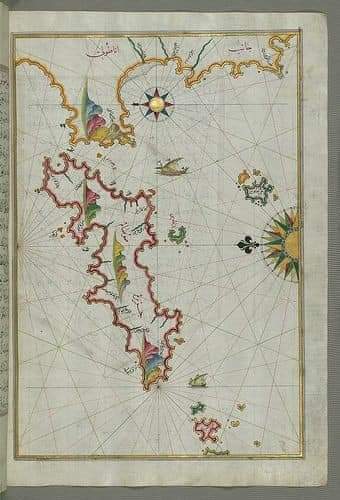
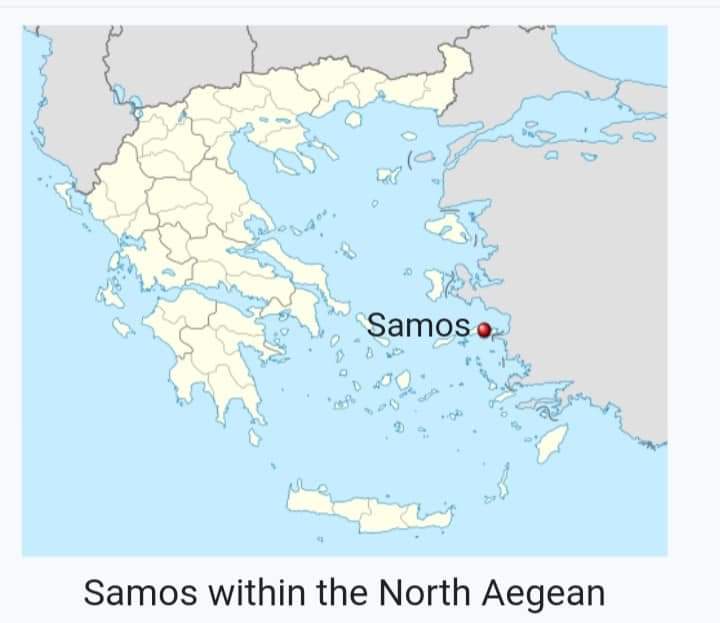
Samos Island, North Aegean, Hellas (Greece)
Samos (Hellenic: Σάμος [ˈsamos]) is a Hellenic island in the eastern Aegean Sea. Strabo derived the name from the Phoenician word sama meaning “high”.
Samos is the birthplace of the Hellenic philosopher and mathematician Pythagoras, after whom the Pythagorean theorem is named, the philosophers Melissus of Samos and Epicurus, and the astronomer Aristarchus of Samos, the first known individual to propose that the Earth revolves around the sun.
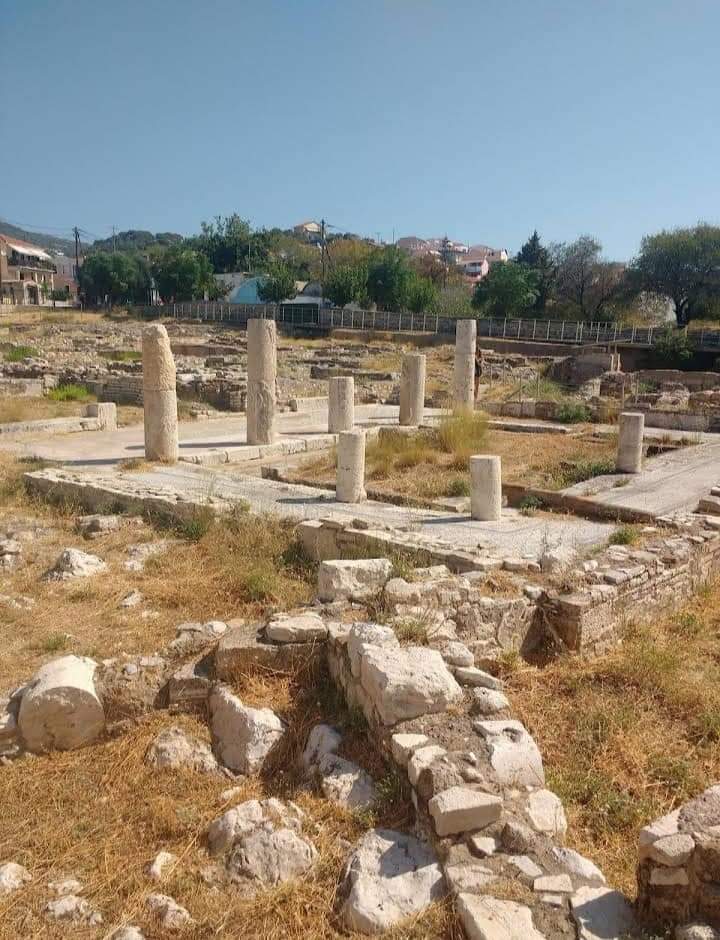
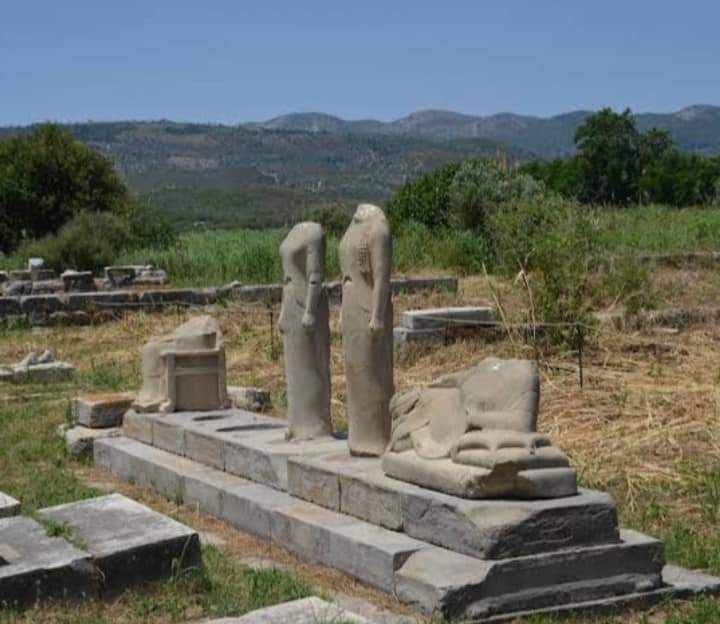
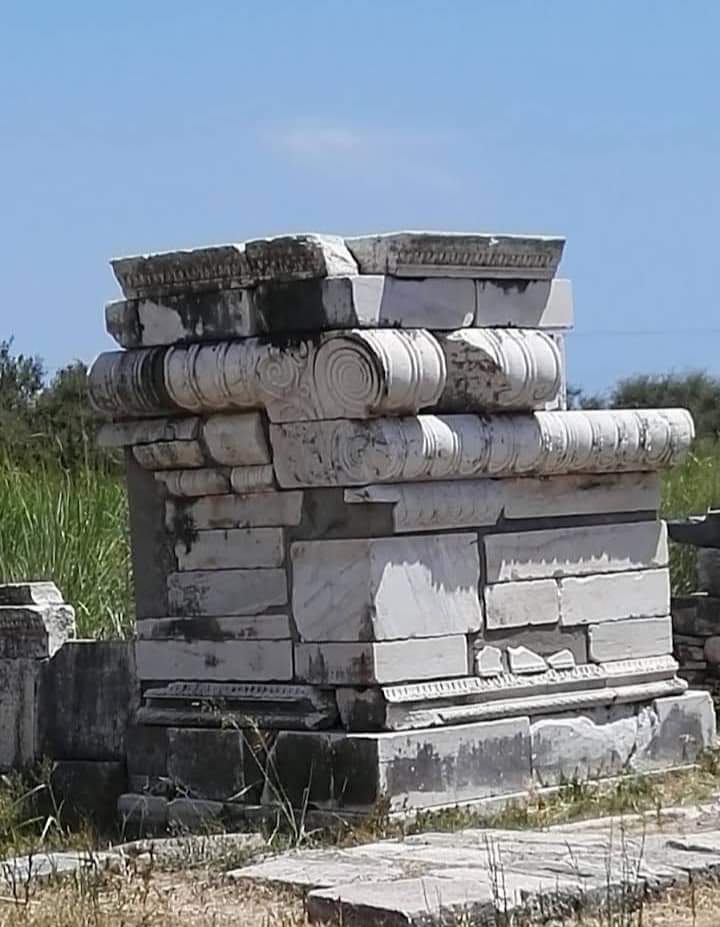
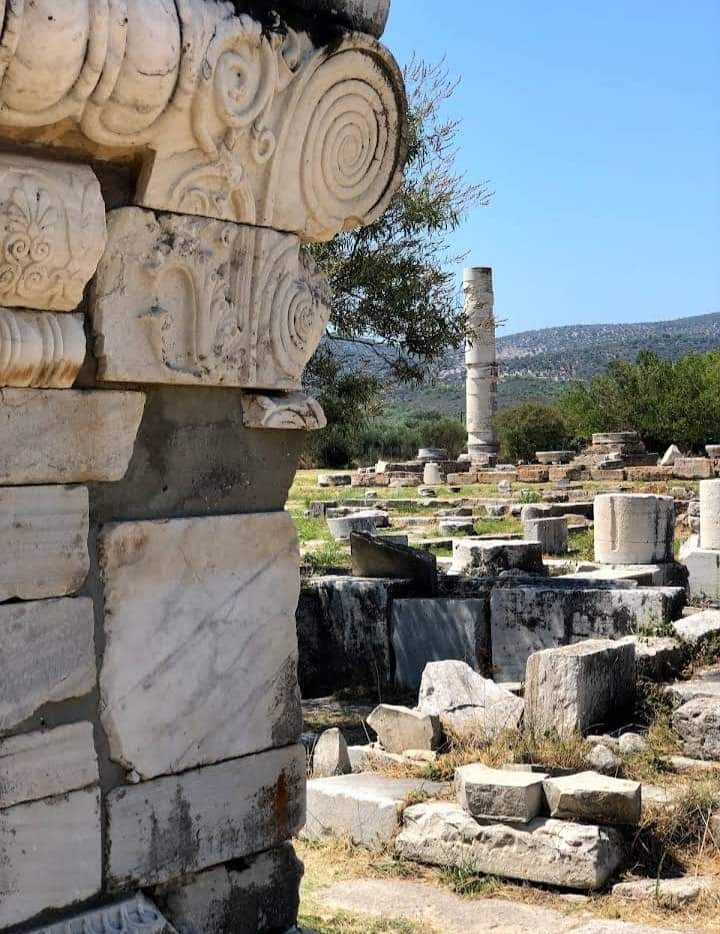
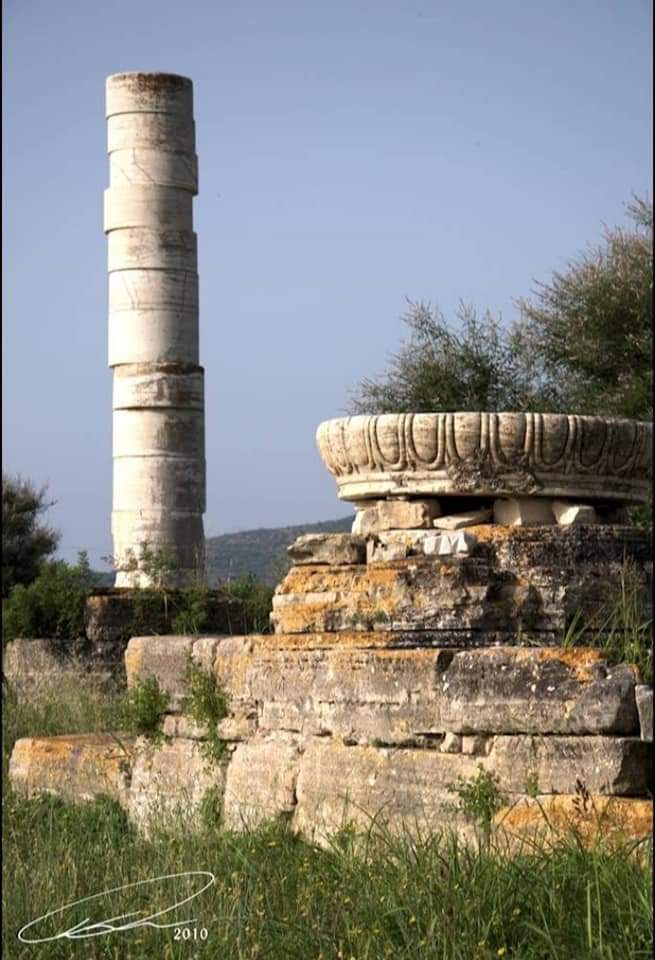
In classical antiquity, the island was a center of Ionian culture and luxury, renowned for its Samian wines and its red pottery (called Samian ware by the Romans). Its most famous building was the Ionic order archaic Temple of goddess Hera—the Heraion.
At the time of the great migrations, Samos received an Ionian population which traced its origin to Epidaurus in Argolis and became one of the twelve members of the Ionian League. By the 7th century BC, it had become one of the leading commercial centers of Hellas.
They established trade with the population that lived around the Black Sea as well as with Egypt, Cyrene (Libya), Corinth, and Chalcis. This caused them to become bitter rivals with Miletus. Samos was able to become so prominent despite the growing power of the Persian empire because of the alliance they had with the Egyptians and their powerful fleet. The Samians are also credited with having been the first Hellenes to reach the Straits of Gibraltar.
The feud between Miletus and Samos broke out into open strife during the Lelantine War (7th century BC), with which we may connect a Samian innovation in Hellenic naval warfare, the use of the trireme. The result of this conflict was to confirm the supremacy of the Milesians in eastern waters for the time being; but in the 6th century, the insular position of Samos preserved it from those aggressions at the hands of Asiatic kings to which Miletus was henceforth exposed. About 535 BC, when the existing oligarchy was overturned by the tyrant Polycrates, Samos reached the height of its prosperity. Its navy not only protected it from invasion but also ruled supreme in Aegean waters. The city was beautified with public works, and its school of sculptors, metal-workers and engineers achieved high repute.
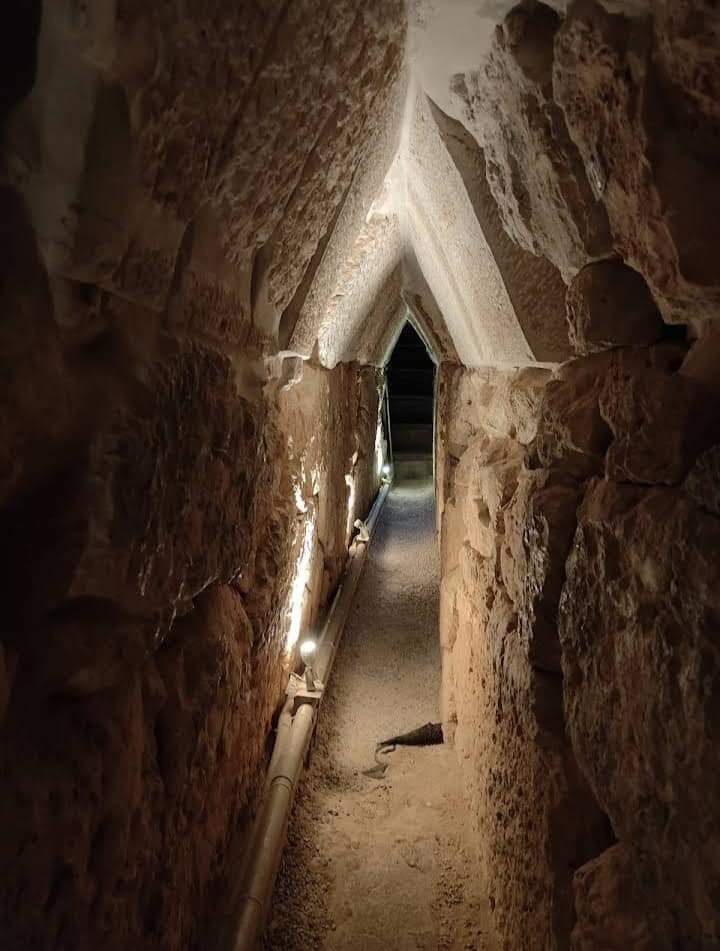
In the 6th century, BC Samos was ruled by the famous Polycrates. During his reign, two working groups under the lead of the engineer Eupalinos dug a tunnel through Mount Kastro to build an aqueduct to supply the ancient capital of Samos with fresh water, as this was of the utmost defensive importance (since being underground, it was not easily detected by an enemy who could otherwise cut off the supply). Eupalinos’ tunnel is particularly notable because it is the second earliest tunnel in history to be dug from both ends in a methodical manner. Eupalinos’ subterranean aqueduct is today regarded as one of the masterpieces of ancient engineering.
After Polycrates’ death, Samos suffered a severe blow when the Persian Achaemenid Empire conquered and partly depopulated the island. It had regained much of its power when in 499 BC it joined the general revolt of the Ionian city-states against Persia; but owing to its long-standing jealousy of Miletus, it rendered indifferent service, and at the decisive battle of Lade (494 BC), part of its contingent of sixty ships was guilty of outright treachery. In 479 BC, the Samians led the revolt against Persia, during the Battle of Mycale, which was part of the offensive by the Delian League (led by Cimon).
In the Delian League, Samos held a position of special privilege and remained actively loyal to Athens until 440 BC, when a dispute with Miletus, which the Athenians had decided against them, induced them to secede. With a fleet of sixty ships, they held their own for some time against a large Athenian fleet led by Pericles himself, but after a protracted siege, were forced to capitulate. It was punished, but Thucydides tells us not as harshly as other states which rebelled against Athens. Most in the past had been forced to pay tribute, but Samos was only told to repay the damages that the rebellion cost the Athenians.
During the Peloponnesian War (431–404 BC), Samos took the side of Athens against Sparta, providing their port to the Athenian fleet. This friendly attitude towards Athens was the result of a series of political revolutions, which ended in the establishment of a democracy. After the downfall of Athens, Samos was besieged by Lysander and again placed under an oligarchy.
In 394 BC, the withdrawal of the Spartan navy induced the island to declare its independence and reestablish a democracy, but by the peace of Antalcidas (387 BC), it fell again under Persian dominion. It was recovered by the Athenians in 366 after a siege of eleven months, and received a strong body of military settlers, the cleruchs, which proved vital in the Social War (357-355 BC). After the Lamian War (322 BC), when Athens was deprived of Samos, the vicissitudes of the island can no longer be followed.
Perhaps the most famous persons ever connected with classical Samos were the philosopher and mathematician Pythagoras and the fabulist Aesop.
Other notable personalities include the philosophers Melissus of Samos and Epicurus, who were of Samian birth, and the astronomer Aristarchus of Samos, whom history credits with the first recorded heliocentric model of the solar system. The historian Herodotus, known by his Histories, resided in Samos for a while.
For some time (about 275–270 BC), Samos served as a base for the Egyptian fleet of the Ptolemies; at other periods, it recognized the overlordship of Seleucid Syria. In 189 BC, it was transferred by the Romans to their vassal, the Attalid dynasty’s Hellenistic kingdom of Pergamon, in Asia Minor.
As a portion of the Byzantine Empire, Samos became part of the namesake theme. After the 13th century, it passed through much the same changes of government as Chios, and, like the latter island, became the property of the Genoese firm of Giustiniani (1346–1566; 1475 interrupted by an Ottoman period). It was also ruled by Tzachas between 1081–1091.
Samos came under Ottoman rule in 1475 or c. 1479/80, at which time the island was practically abandoned due to the effects of piracy and the plague. The island remained desolate for almost a full century before the Ottoman authorities, by now in secure control of the Aegean, undertook a serious effort to repopulate the island.
In 1572/3, the island was granted as a personal domain (hass) to Kilic Ali Pasha, the Kapudan Pasha (the Ottoman Navy’s chief admiral). Settlers, including Hellenes and Arvanites from the Peloponnese and the Ionian Islands, as well as the descendants of the original inhabitants who had fled to Chios.
Ottoman rule was interrupted during the Russo-Turkish War of 1768–1774, when the island came under Russian control in 1771–1774.
The Samians successfully repulsed three Ottoman attempts to recapture the island: in summer 1821, in July 1824; when Hellenic naval victories off Samos and at Gerontas averted the threat of an invasion, and again in summer 1826. In 1828, the island became formally incorporated into the Hellenic State under Governor Ioannis Kapodistrias, as part of the province of the Eastern Sporades, but the London Protocol of 1830 excluded Samos from the borders of the independent Hellenic state.
The island was united with the Kingdom of Hellas (Greece) in 1913, a few months after the outbreak of the First Balkan War.
Some Famous people from Samos:
- Aesop (Storyteller).
- Aristarchus of Samos (3rd century BC), astronomer and mathematician, the first known individual to propose that the Earth revolves around the sun.
- Duris of Samos (4th-3rd century BC), historian.
- Epicurus (4th century BC), philosopher, founder of the Epicurean school of philosophy.
- Melissus of Samos, philosopher.
- Polycrates (6th century BC), tyrant of Samos.
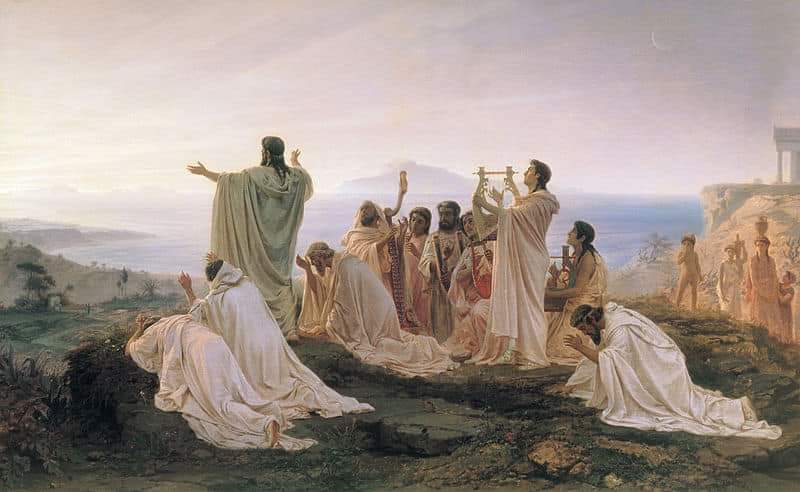
- Pythagoras (6th century BC), philosopher, mathematician, and religious leader, after whom the Pythagorean theorem is named (‘the square on the hypotenuse of a right-angled triangle is equal to the sum of the squares on the other two sides’).
- Theodorus (6th century BC), sculptor and architect.

 KGOSINKOTSI 📚